AI for Restoration
AI Restoration Software — Dispatch, Scheduling & Documentation
Documentation insurers pay without arguing — on every loss, at any hour
Restoration work is won at 2am and paid months later — and what decides whether the cheque comes easily is the file: when the crew arrived, what they extracted, what they placed, with photos to prove all of it. loTouch dispatches crews around the clock, GPS-stamps and photo-documents every visit from first response to final dry-down, and turns that file into invoices an adjuster approves the first time.

What does restoration business software do?
Restoration business software dispatches crews to water, fire and mould losses around the clock, and documents every visit with GPS-stamped times and photos — the file insurers pay without arguing. Equipment placement, daily monitoring visits and final invoices all flow from the same job record. loTouch adds generated landing pages per neighbourhood, so emergency searches find your company first.
Sound familiar?
The problems eating your margin
The 2am call finds your dispatch asleep
A burst pipe doesn't wait for office hours, and neither does the competitor across town. loTouch routes after-hours emergencies to the on-call crew by proximity and capability, with the customer watching the arrival window instead of wondering if anyone is coming.
Claims stall on missing documentation
An adjuster who can't see when you arrived, what you removed and what readings justified four air movers will argue every line. Every visit closes with GPS-stamped times, moisture readings, photos and equipment placed — a file that answers questions before they're asked.
Monitoring visits drift and equipment goes missing
A dehumidifier left behind on a closed job is pure cost; a missed daily reading reopens a 'dry' file. loTouch schedules monitoring visits through the dry-down automatically and tracks every piece of equipment by job until it's back on the truck.
Curious what drive time costs you? Try the calculator — preset for restoration→
How it works
How loTouch works for Restoration
loTouch is the restoration management software for work won at 2am and paid months later. The dispatch software routes after-hours water, fire and mould losses to the on-call crew nearest the address with the right capability, and route optimization sequences monitoring visits as crews travel between active jobs. The scheduling software books daily dry-down visits automatically and tracks every piece of equipment by job until it's back on the truck. Each visit closes with GPS-stamped times, moisture readings and photos — the file an adjuster approves without arguing — and the billing software generates invoices from documented visits with the deductible billed separately. The booking software puts your brand in front of the panicked midnight search.
See transparent pricing and estimate your total for restoration→
The loTouch effect
What changes with loTouch
Be the company the panicked search finds
Generated landing pages per neighbourhood for water damage, fire and smoke, and mould remediation — ranking when a homeowner is standing in a flooded basement at midnight.
A crew app that builds the claim file as it works
Arrival and completion GPS-stamped automatically; readings, photos and equipment logged per visit; scope changes documented on-site — the paper trail assembles itself while the crew dries the structure.
Insurance-grade records, homeowner-grade communication
The same record that satisfies the adjuster keeps the homeowner informed — visit confirmations, daily progress and what happens next, by SMS or email, automatically.
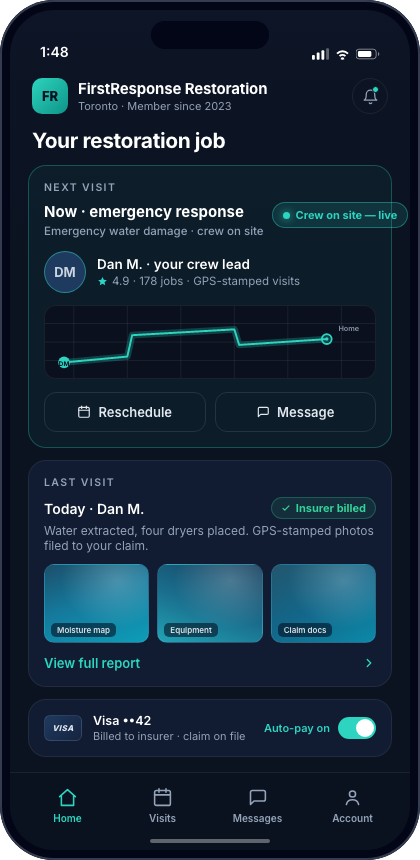
Your customers book, track and pay in your branded app.
Comparing options? loTouch vs ServiceTitan→
The intelligence layer
Intelligence layer for Restoration
AI running a restoration business routes a 2am water, fire or mould loss to the on-call crew nearest the address with the right capability, schedules daily dry-down monitoring visits automatically, and assembles the GPS-stamped, photo-documented file an adjuster approves the first time. Underneath, it watches your referral pipeline — the adjuster, plumber or property manager whose volume has dropped — and surfaces those relationships with a follow-up drafted, so the partner referrals that feed restoration work don't quietly dry up.
Predict churn
Catch a leaving customer before they go.
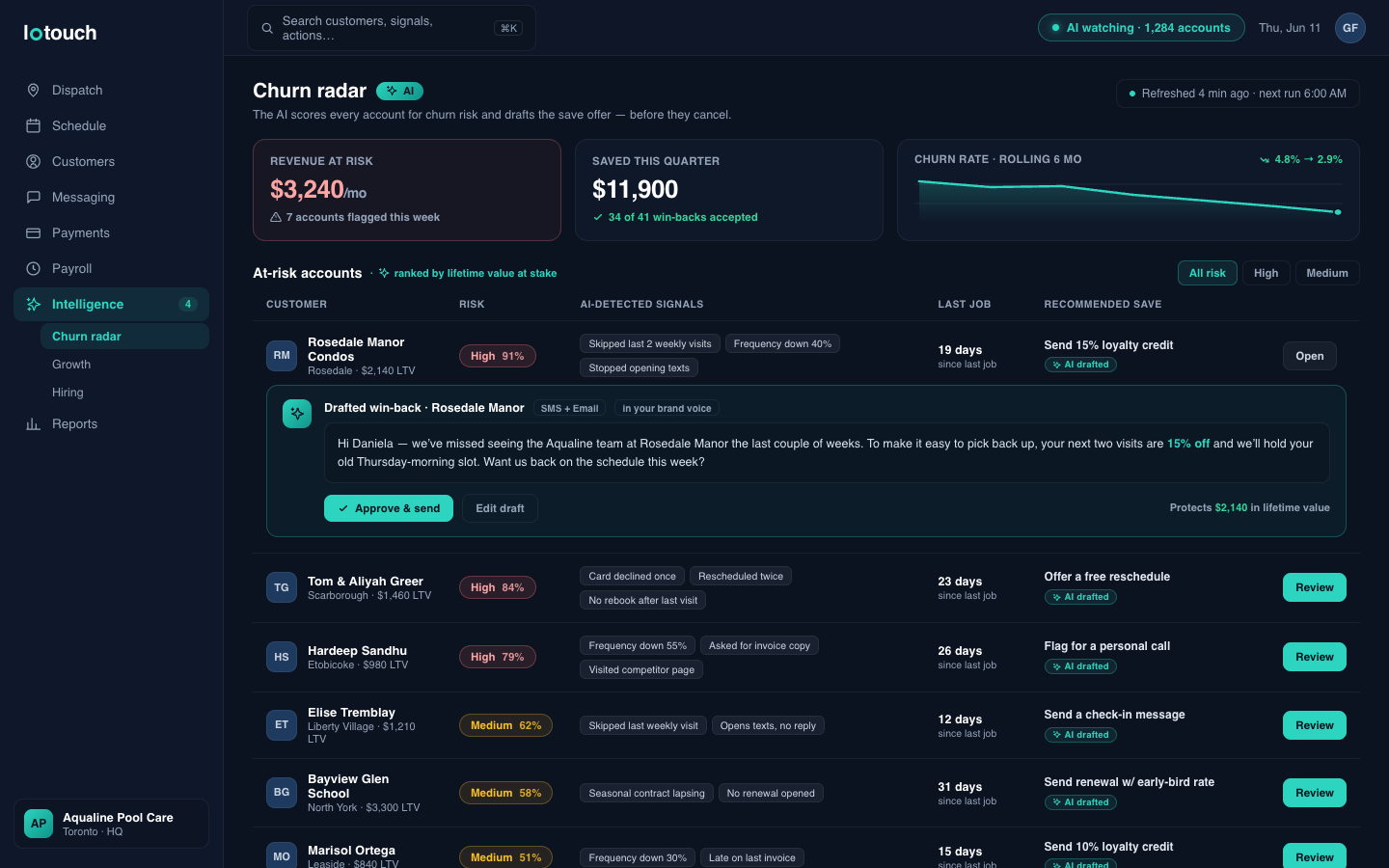
When a referring adjuster, plumber or property manager stops sending you losses, loTouch's churn radar flags the account before they cancel — with the win-back offer already drafted in your voice.
The intelligence layer scores every customer on the quiet signals — skipped visits, frequency falling off, a card that declined — and ranks at-risk accounts by the lifetime value at stake, each with a recommended save and a message drafted ready to send. The AI surfaces and drafts; you approve.
Hire with a built-in ATS
Finding restoration crew technicians is the hard part.
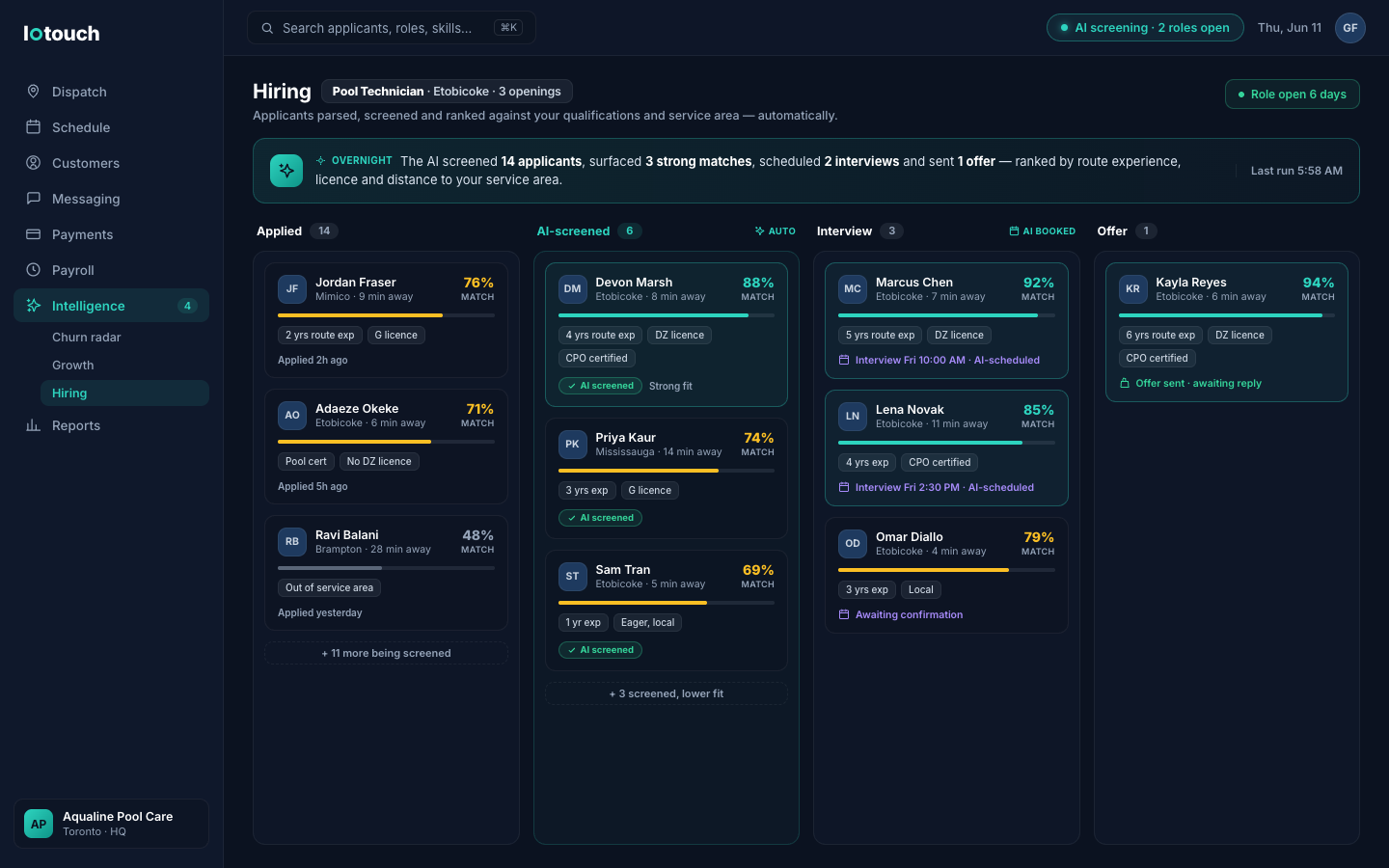
The built-in ATS posts the role, AI screens every applicant overnight, and surfaces the strong matches ranked by fit and drive time — so you wake up to a shortlist, not an inbox.
Post an opening and the AI parses every resume, screens applicants against the qualifications, certifications and service area that matter for restoration companies, ranks them by fit, and books the interviews. Hiring restoration crew technicians stops being a side project and becomes part of the operation the AI runs.
Proven in production
The engine behind loTouch has been running Rockstar Music Central for years
Google page 1
for region + instrument searches across the GTA
$0.90 avg CPC
across 14.6K impressions of supporting paid search
One system
from search result to teacher payroll
FAQ
Questions restoration companies ask us
How does 24/7 emergency dispatch work?
On-call schedules live in the system. An after-hours loss routes to the on-call crew nearest the address with the right capability — water, fire, mould — and the crew lead gets the full job card on their phone. The customer receives the crew's name and a live arrival window immediately.
What documentation do insurers actually get?
Every visit carries GPS-stamped arrival and departure times, photos, moisture readings, equipment placed or pulled, and the crew's notes — assembled per claim and exportable as one package. Adjusters approve files like that without the back-and-forth, which is the difference between paid-in-30 and paid-in-120.
Can it schedule daily monitoring visits through a dry-down?
Yes. Once equipment is placed, monitoring visits book automatically until readings hit target — each one logged with readings and photos. Equipment is tracked per job, so nothing 'dries' on paper while a dehumidifier hums in an empty house, and nothing gets left behind.
How does billing work on insurance-funded jobs?
Job records carry the claim number, adjuster contact and approved scope, and invoices generate from the documented visits — with the homeowner's deductible billed separately, card-on-file. Emergency mitigation and rebuild phases stay on one job, one history, one file.
Can AI run my restoration business?
Yes. loTouch is AI software for restoration companies: you set the standards once — your service area, pricing, scheduling rules, cancellation policy and payroll — and the AI runs the operation day to day. It books and schedules jobs against real availability, dispatches the nearest qualified crew, messages customers, raises invoices, takes card-on-file payment and runs crew payroll. You stay in control of the rules; the AI executes them and surfaces the decisions worth your attention.
What does AI automate for restoration companies?
loTouch's AI automates the full operational loop for restoration companies: online booking, route-optimized scheduling and dispatch, customer messaging, a 24/7 front desk, invoicing, card-on-file payments and crew payroll — all from one record. On top of that, an intelligence layer watches your data and surfaces the smart moves — flagging customers at risk of churning with a drafted win-back, growing lifetime value with repeat-booking nudges, finding underserved neighbourhoods to win, and screening job applicants through a built-in ATS. The AI surfaces and drafts; you approve.
What software do mobile restoration companies use to manage scheduling?
Mobile restoration companies use loTouch — restoration management software that combines online booking, route-optimized scheduling and dispatch software in one platform. Because the team travels to the customer, loTouch assigns the nearest qualified crew, keeps routes dense, and turns every completed job into an invoice, a card-on-file payment and crew payroll from the same record.
How much does restoration software cost?
loTouch pricing is public, not hidden behind a sales call: implementation from $3,500 one-time and a platform license from $400/mo, plus $40 per crew per month — office seats and end customers are free. Most restoration companies land at roughly 1.5–2.2% of annual revenue all-in. See the full model and an instant estimator at lotouch.ca/pricing.
Does loTouch sync with QuickBooks?
Yes — invoices, payments and payroll records sync to QuickBooks, so your accountant keeps their system and you keep one source of truth. Job data stays exportable; loTouch is built to feed your books, not trap your data.
How does loTouch pricing work?
loTouch pricing is public: implementation from $3,500 one-time and a platform license from $400/mo, sized by team (1–10, 11–25 or 26–60 field providers), plus $40 per provider per month — office and manager seats are free, and end customers are free and unlimited. Payments run at standard processor rates plus a platform fee under 1% on card-on-file volume. See lotouch.ca/pricing for the full model and an instant estimator.
Coverage
Available everywhere you operate
Local landing pages, local scheduling, local routing — wherever your teams work.
Canada
Get started
Tell us about your restoration operation
- 1
Tell us about your operation
Two minutes in the form below — team size, regions, what you run on today.
- 2
See it on your own use case
A walkthrough call, not a sales script.
- 3
Get a scoped proposal
Within days, not months.
- Proven in production — runs a real multi-region business today
- Google page-1 results behind the case study
- A human replies within one business day